
Four rules of dry stone walling
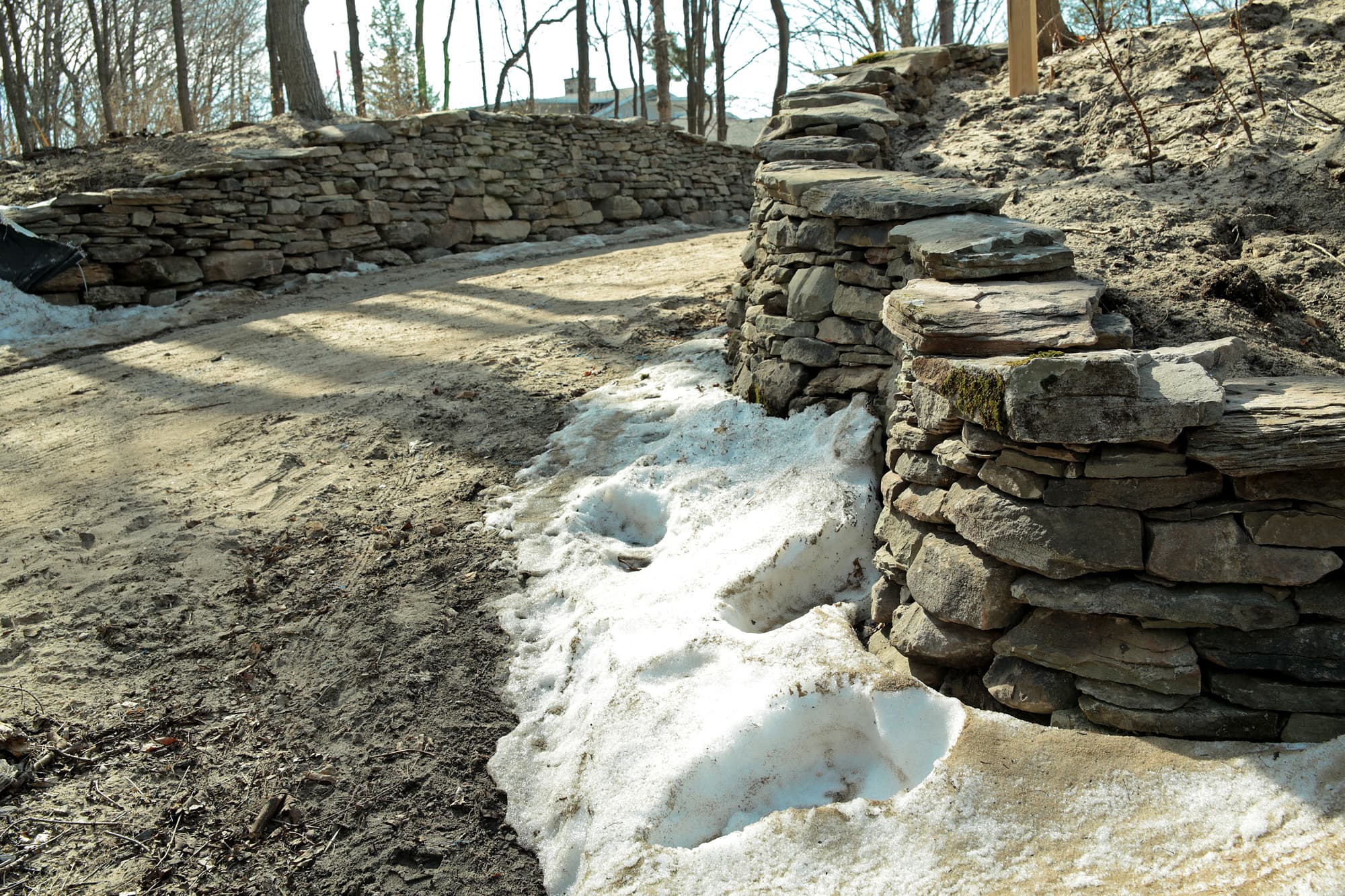
The minimum vocabulary of the craft. Everything else is a special case of these four rules.
Every vertical joint must be covered by the stone above. A running joint is a fault line waiting for weather, settlement, and gravity to make use of it.
The rule applies at every scale. If it must be broken, the exception has to announce itself and earn its place structurally.
A stone with its long face displayed to the outside is usually a stone that has failed to do enough work. The length belongs in the depth of the structure, not on show.
This is why the most beautiful face of a stone is often invisible in the finished wall. That is not a loss. It is the point.

Each course holds level along its top even when the wall as a whole climbs or falls across ground. Tilt the stones and they begin working downhill under their own weight.
The heart of the wall is not rubble. It is packed stone, placed from inside, beneath, and between as the wall rises. Good hearting is structural, not incidental.